

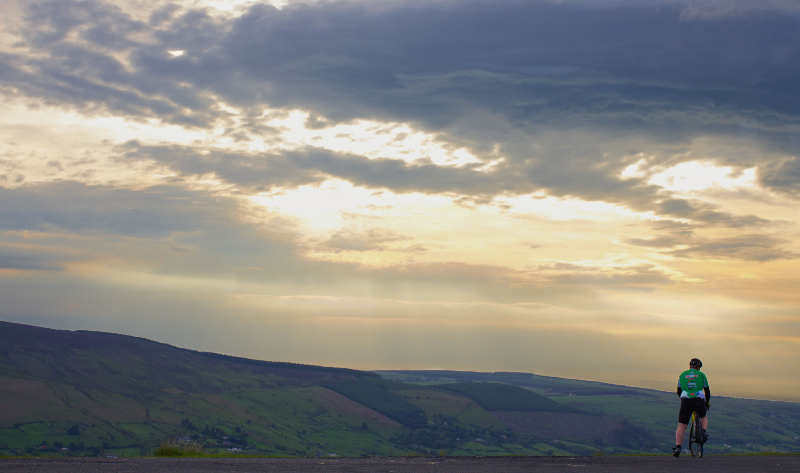
At five o’clock this morning I was reminded, once again, that I am not the undisputed owner of the Yorkshire Dales.
The curlews had other ideas.
Anyone who spends time cycling across the moors in spring and early summer will know exactly what I mean.
One moment you’re enjoying the peace of an empty road, the next you’re being dive bombed by a furious curlew determined to protect its young.
There is usually a warning call, followed by a dramatic aerial display and then, seemingly from nowhere, a swooping attack that passes inches above your head.
No matter how many times it happens, it still catches you by surprise and especially before your second coffee of the day!
This morning was no different. The roads were empty, the air was still and the sun was only just beginning to lift above the hills. Then came the unmistakable cry, followed by an angry curlew banking sharply before launching another attack run.
The remarkable thing is that the bird isn’t acting aggressively for the sake of it. It is doing exactly what nature designed it to do. It has identified a perceived threat and is responding instinctively to protect what matters most. Yep, a man of a certain age in Lycra attracting the disdain of wildlife and motorists in equal measure.
As I pedalled on, it struck me that there are some surprising parallels between those encounters on the moors and many of the organisations I have worked with throughout my career.
In some businesses, protective “curlew bombing” has become the norm.
New ideas are attacked before they are understood. External expertise is viewed with suspicion. Challenging questions are met with hostility. Individuals who point out risks, weaknesses or uncomfortable truths often find themselves on the receiving end of defensive reactions.
The intention is usually not malicious. Like the curlew, people are often protecting something they care deeply about. Their team. Their department. Their reputation.
Their budget. Their way of working.
The problem arises when protection becomes resistance.
Over the years I have seen organisations spend enormous amounts of time defending existing processes that were clearly no longer fit for purpose. Leaders become emotionally invested in decisions made years earlier. Teams become territorial about responsibilities. Departments build invisible walls that prevent collaboration.
Meanwhile, the risks continue to evolve around them.
The retail crime landscape provides a good example. Organised criminal groups constantly adapt their methods. Fraudsters look for weaknesses in online processes. Violent offenders exploit gaps in colleague safety measures. Yet some organisations still react defensively whenever existing controls are challenged.
The conversation quickly moves from “How do we improve?” to “Why are you criticising what we’ve already done?”
That is when progress slows.
The best organisations I have worked with behave very differently. They remain curious. They welcome constructive challenge. They understand that identifying a weakness is not an attack on the business; it is an opportunity to strengthen it.
Strong leaders recognise that defending the status quo is rarely a strategy for long-term success.
As I climbed higher onto the moor this morning, another curlew launched itself from the heather and made a determined pass directly over my shoulder. I nearly jumped out of my skin despite fully expecting it.
That is perhaps the most interesting lesson of all.
Even when you know the attack is coming, it can still catch you off guard.
The same is true in business. Resistance to change is predictable. Organisational defensiveness is predictable. Internal politics are predictable. Yet they still have the ability to surprise and disrupt progress when you least expect it.
The difference is that the curlew is protecting its young. Many organisations are simply protecting their comfort zone.
As for me, I’ll continue my early morning rides across the Yorkshire Dales. After all, my worst day on the Yorkshire moors is still better than a half decent day in the boardroom.