

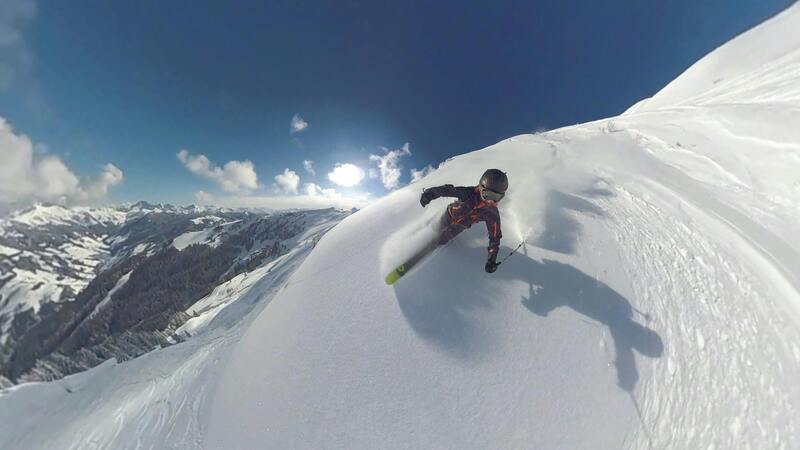
I have loved watching the Winter Olympics over the past couple of weeks.
Alongside the incredible display of sporting greatness, with Team GB securing an impressive five gold medals, the scenery has been equally spectacular.
But beauty is a double-edged sword, and beneath the picturesque white powdery snow lies the ever-present potential for something far more sinister…
Since January, Europe has seen a spike in avalanche-related deaths. There was also a deadly avalanche in California, which sadly took the lives of nine skiers.
It is not unusual for avalanches to be in the news in the northern hemisphere at this time of year. It is the height of the annual ski season after all. But there does appear to be renewed focus on one of the most dangerous natural phenomena in the mountains.
Alongside recent stormy weather, experts have claimed that changing skier behaviour is contributing to the increase in incidents in the Alps. Blaise Agresti, a high-mountain guide at Chamonix, told France’s Sud radio that “people are increasingly practising off-piste skiing,” which involves higher levels of risk-taking.
Way-marked pistes are generally protected by pre-emptive avalanche blasting, and their snow is flattened and compacted to further reduce the risk. If there is still a danger of avalanches, these pistes can be closed off entirely, as we have seen during recent warnings.
Whilst some measures are in place to improve safety off-piste, any movement into unmanaged terrain naturally increases exposure to unstable snowpacks and hidden weak layers.
Although the recent spike in avalanche deaths is worrying, data from the European Avalanche Warning Services suggests that the overall number of skier fatalities has remained relatively stable over time. And that is despite growing participation and increased off-piste activity.
That relative stability is being attributed to advancements in mountain safety systems, including more accurate avalanche forecasting, improved transceiver technology, and coordinated cross-border warning systems. So whilst exposure may be increasing, these developments – combined with real-time weather modelling and GPS-enabled rescue tools – are helping to strengthen avalanche risk management.
And that got me thinking, because a very similar thing is happening in retail risk management right now.
In skiing, behaviour has shifted. More winter sports enthusiasts are going beyond the managed slopes and into less controlled environments. In retail, I see organised retail crime gangs doing much the same.
Historically, theft was concentrated in-store. That was the “piste”, if you like; visible, monitored, and, thanks to the sustained target-hardening efforts of retailers, comparatively controlled. But much like today’s skiers heading off-piste, organised groups are increasingly moving beyond the shop floor by targeting vulnerabilities elsewhere in the supply chain…
Fortunately, just as in avalanche forecasting and mountain safety management, technology is helping us to keep risk in check.
From facial recognition and behavioural analytics to vehicle tracking systems and drone-supported perimeter monitoring at large distribution sites, retailers now have a far more sophisticated toolkit at their disposal to detect emerging threats earlier, respond faster, and reduce the opportunity for organised groups to operate undetected.
But if there is one thing mountain safety can teach us, it is that technology alone is never enough; intelligence sharing plays a critical role too.
In the same way that avalanche forecasters rely on distributed observations from guides, patrol teams, and skiers, our industry is increasingly recognising the importance of sharing insight – particularly when it comes to supply chain loss, which has historically been something of a data blind spot.
I was struck recently by comments from Thomas Hager, a ski guide based in the Zell am See region of the Austrian Alps, speaking on the BBC World Service’s Outside Source programme. He made a point that feels just as relevant to retail as it does to skiing…
“Snow looks so calm. It’s comparable to water,” he said. “In an ocean you don’t see undercurrents, but local people know where the undercurrents are and where avalanches go off frequently. So please always talk with local people and listen to the avalanche forecast.”
I think that is a powerful lesson. In skiing, ignoring local insight or the avalanche bulletin can have fatal consequences. In retail, ignoring shared intelligence can mean walking straight into preventable loss.
That is why conferences like Retail Risk – On The Move are so important. In less than four weeks’ time, ASEL will be exhibiting there, and I always value the opportunity to connect with industry peers, share insights, and explore practical strategies for managing supply chain risk more effectively.
I am also very much looking forward to hearing the results of the new industry-wide survey that may have landed in your inbox recently. Focused on logistics crime impacting retail distribution, the survey will help us to build a clear, evidence-led picture of where logistics crime is really hurting, how it is evolving, and which controls are genuinely working.
For me, this is the retail equivalent of the avalanche forecast. It gives us shared visibility. It helps us see the undercurrents. And it allows us to make better decisions before instability turns into something far more damaging…