

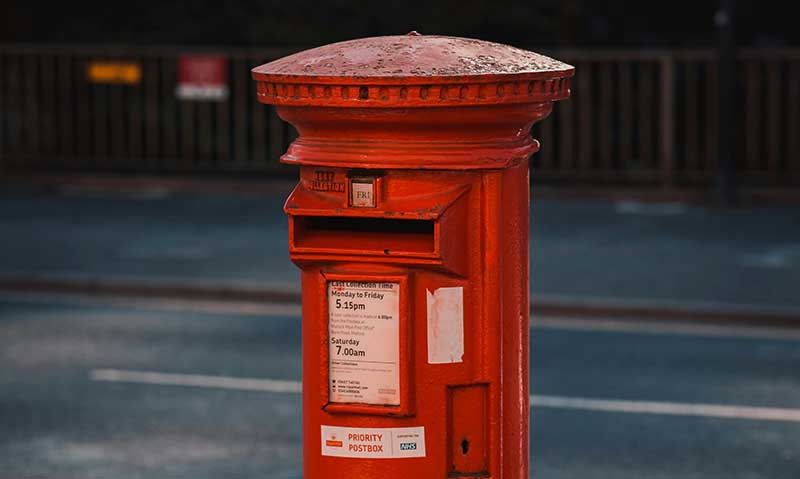
Royal Mail’s troubles raise uncomfortable questions about risk and resilience in a changing climate…
The recent bad weather has certainly done its best to keep us on our toes.
Last week, I wrote that the destruction following Storm Chandra had led to the discovery of part of a 400-year-old shipwreck. This week, the fallout from the meteorological mayhem is decidedly less romantic…
I suspect many readers will have experienced delays with Royal Mail in recent months. Whistleblowers have claimed that delivery rounds are being missed daily, with postal workers telling the BBC that some letters sit in depots for weeks. Meanwhile, parcels are reportedly being prioritised over letters as the business attempts to protect higher-margin services.
Royal Mail has blamed the current crisis in the postal system on adverse weather, including storms Goretti, Ingrid and Chandra in January, as well as higher-than-usual sickness absence.
But the fallout amounts to more than the mild irritation of a late birthday card. People are receiving medical appointment letters after the appointment itself has passed, while others report missing school certificates and bank statements.
Whilst I am fortunate enough not to have suffered anything quite so consequential, I have noticed the growing unpredictability of the morning post. We can go for days at a time without receiving a delivery… It’s just a shame that the one item that never seems to lose its way is a utility bill!
The situation has escalated to the point that ministers have now intervened, with the Business and Trade Committee of MPs writing to the company to demand answers as to what has gone wrong and how it intends to restore service standards.
I know the weather has been particularly wet, but one has to ask: how surprised can we really be? Across the UK, as in much of the world, severe weather events are becoming more frequent and more intense.
According to Met Office data, the 2023–24 storm season was among the wettest on record. The 2024–25 season then brought Storm Éowyn, the most powerful windstorm to hit the UK in over a decade. And just this week, the UK Centre for Ecology & Hydrology confirmed that in January 2026, some parts of the country recorded their highest rainfall totals ever.
More worrying still, a recent study has suggested that UK winters are set to get even wetter thanks to climate change. Research from the University of Newcastle indicates that for every 1°C of global warming, winter rainfall will increase by 7%.
“The findings from our research show that climate change has already made our winters significantly wetter, with a 7% increase in rainfall per degree of global warming,” said lead author, Dr James Carruthers.
“This is really concerning, as seasonal rainfall is increasing at a much faster rate than global climate models have predicted. We’re already experiencing changes in UK winter rainfall that global climate models predict for the 2040s – we’re 20 years ahead.”
Whilst global warming and its effects are still controversial in some quarters, not least with Donald Trump doing everything in his power to deny its very existence, from where I’m sitting the science is increasingly difficult to ignore, and anyone who chooses to disregard it does so at their peril. Even China, historically the world’s largest emitter, has invested heavily in renewables and now leads globally in solar and wind capacity.
So, given that we have empirical data that indicates more severe storms and heavier rainfall happening much more regularly, how great a priority should we give to modelling the risk in our businesses and evolving our operations in anticipation of such extreme weather events?
If you look at what has transpired at Royal Mail, the answer would appear to be “a lot!”
Of course, I am certain not all of the company’s challenges can be laid at the feet of the recent storms. Operational pressures, structural change, and industrial relations will no doubt all play their part. But it does underline the critical importance of contingency planning and adaptive resilience.
Speaking on the increased risk of climate-related flooding, Ellie Murtagh, UK Climate Adaptation Lead at the British Red Cross, said: “We know from our work across the UK that flooding has a devastating impact on people’s lives. Heavy downpours linked to climate change are making our winters wetter and flooding more likely.
“It is crucial we adapt and manage this risk. We will continue to work alongside the government, emergency services and other charities to protect our homes, our livelihoods and the most vulnerable in our communities.”
However, it is not just climate-related risks that demand attention. In Royal Mail’s case, “higher-than-usual sick absence” has compounded the current disruption. We do not need to reach far back into memory to recall what systemic illness can do to business continuity. The Covid-19 pandemic exposed how vulnerable many organisations were to workforce shocks, supply chain fragility and a lack of scenario planning.
And whilst I sincerely hope events on that scale are a once-in-a-lifetime occurrence, even seasonal flu, norovirus outbreaks or regional health crises can materially disrupt operations if suitable resilience measures and staffing contingencies are not in place.
At ASEL, we have been adapting our risk modelling to take into account potential business interruption by virtue of systemic shocks such as climate volatility. It is a complex business and not in the wheelhouse of many traditional loss prevention and risk managers.
So, whether you don’t know where to start or would like to compare your risk model against ours, which obviously takes in a wider database than a single retail business to provide “answers”, please get in touch.