

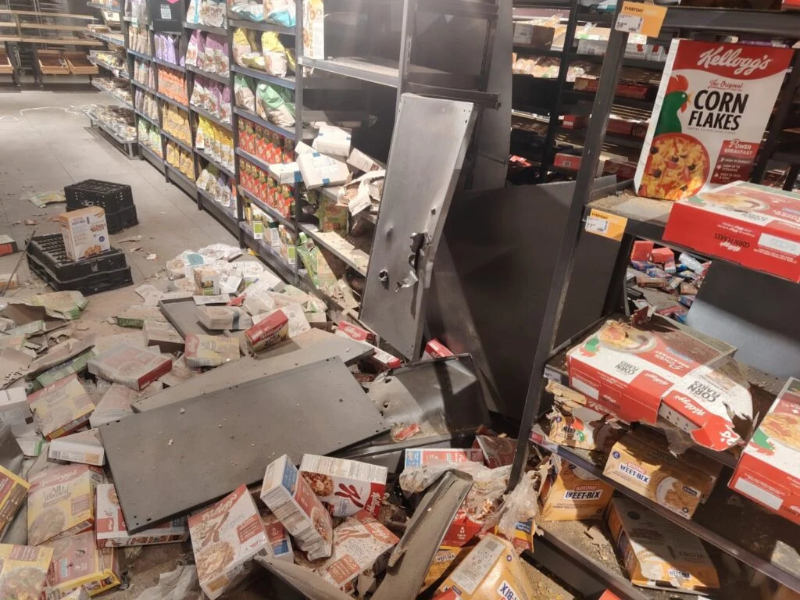
South Africa’s retail community is facing a deeply troubling moment after two explosive devices were detonated at Woolworths stores in two different provinces within little more than 24 hours.
The first incident took place in the early hours of Thursday 28th May at Woolworths Menlyn Park in Pretoria. According to police reports, an unknown device detonated inside the store at around 1am while staff were still on site.
Five packers were reportedly working inside the store at the time. Thankfully, no injuries were reported, and damage was limited to stock and shelving. Business Tech published photos of the aftermath.
The following morning, Friday 29th May, a second explosion was reported at Woolworths Preller Square in Bloemfontein. Again, thankfully, there were no injuries reported. But the incident prompted a significant emergency and policing response, with the Hawks’ Serious Organised Crime Investigation unit now involved in the Bloemfontein investigation.
In their official statement, Woolworths confirmed that improvised explosive devices were detonated in both stores. The retailer has also said it is cooperating fully with authorities, has increased vigilance across its estate, and is providing support to staff affected by the incidents.
At this stage, no motive has been publicly established. Nor have any arrests been reported. While South African police have cautioned that it is too early to classify the incidents or speculate on whether they are linked – the timing, target, and nature of the attacks are plainly being treated with the seriousness they deserve.
For those outside South Africa, this may not yet have registered as a major international retail story. It should.
Retailers everywhere understand the potent threats of theft, fraud, aggression and disruption. Likewise, those retailers are increasingly confronted by organised offending, hostile confrontations, intimidation and targeted attacks.
But explosive devices inside retail stores are a different kettle of fish. Such incidents represent an order of threat that endangers workers, disrupts public confidence, and places enormous pressure on already stretched response systems.
No one was injured in these incidents, but that fact shouldn’t – and can’t – lead to complacency. The level of danger here is severe. Staff were present in at least one of the stores. The incidents occurred inside trading environments used daily by workers, customers, contractors and delivery teams. Had the timing, device placement or circumstances been different, the consequences could have been far worse.
This is precisely why the response cannot sit with any one retailer alone.
Threats of this nature require collaboration between retailers, shopping centre operators, police, private security providers, emergency services, intelligence teams, landlords, insurers and government. They also require fast, accurate information-sharing – not rumour or speculation, but clear channels through which patterns, suspicious activity, threats and attempted incidents can be escalated quickly.
For retail leaders, the immediate questions are practical as well as strategic. Are store teams confident in what to do if they identify a suspicious item? Are overnight workers and contractors properly included in emergency planning? Do tenants understand shopping centre evacuation and lockdown procedures? Are CCTV, access logs, guarding reports and incident data being reviewed in a joined-up way? Are retailers able to share relevant intelligence with each other without delay?
These are hardly abstract concerns. In any major retail incident, the first people exposed are often ordinary store workers doing ordinary shifts: replenishing shelves, cleaning, receiving deliveries, preparing the shop floor before customers arrive. Their safety has to be central to the conversation.
It is also important that South Africa’s retail sector is not left to carry this anxiety in isolation. Retail Risk has long argued that the most serious threats facing retailers can only be met collectively. That principle matters even more in moments like this.
The investigations will determine what happened, who was responsible, and whether the two incidents were connected. Until then, the responsible position is vigilance without panic, solidarity without speculation, and practical collaboration across the sector.
South Africa’s retail colleagues deserve support, attention and a serious industry response. These attacks may have happened thousands of miles away from many of us, but the questions they raise are familiar to retailers everywhere: how do we protect our people, share intelligence quickly, and respond together when retail becomes a target?
The answer cannot be found in isolated action. It has to be collective.