

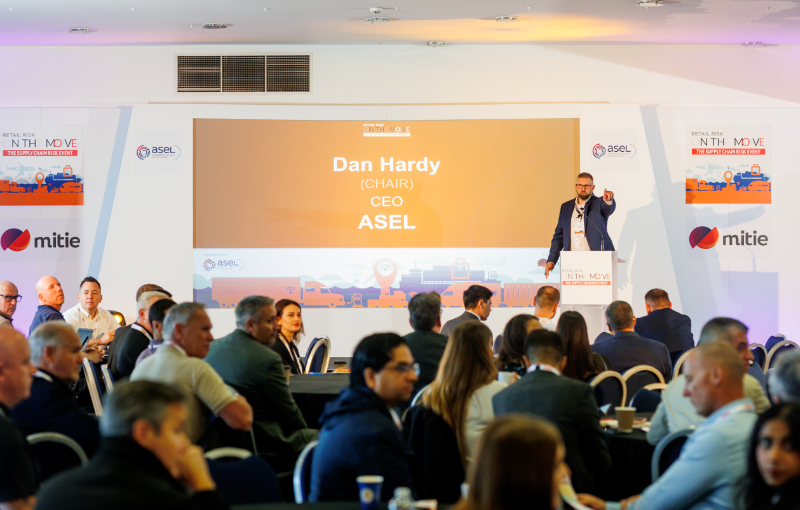
Because all good things must come to an end…
Coming to the end of anything meaningful has a way of sharpening the senses.
It makes you reflective in a way that the day-to-day rarely allows.
It encourages you to look back over your time in post and contemplate not just what you did, but what it meant and, perhaps more interestingly, what it might have achieved.
And so, with my time as ASEL CEO coming to an end, I hope, dear reader, you will excuse me for indulging in a little retrospection. After all, if one cannot cast a mildly sentimental eye over proceedings at a moment like this, when can one?
I was the Global Head of Security for TUI when I was first approached by the ever-persuasive Frank Argentbright to take on the role of Group Managing Director.
Frank, as many of you will know, does not deal in half measures, and once I fully understood the seismic shift that he and his team had planned for the provision of security in the UK and Europe, I knew I had to be a part of it.
And what a ride it’s been…
I am sure that when I am old and grey (no, I’m not there yet, despite what Mrs. Hardy might say!) I will cherish the many highs that I have been lucky enough to experience over the past two years.
There have been moments of real pride, flashes of genuine innovation, and, perhaps most importantly, a quiet satisfaction that comes from working alongside truly remarkable people who care deeply about what they do.
Delivering my inaugural address to the ASEL team and our customers in the iconic Churchill War Rooms – the very building from which the British Government directed its forces during the Second World War – has to be up there with my top career highlights.
It was one of those slightly surreal, pinch-yourself occasions where history, symbolism and a sense of purpose all collided rather neatly. Definitely one for the autobiography, should I ever be tempted to inflict one on the world!
At a moment like this, it would be easy to look back through rose-tinted glasses and curate a narrative that is all triumph and no turbulence. But in the interests of honesty, I won’t do that. Because whilst I have had a great time heading up what I still believe is one of the most ambitious security propositions in Europe, I have to admit that I leave feeling a little disappointed with the security industry as a whole.
Let me explain…
Too often, I have seen a tendency toward saying the right things without doing the hard things. Standards are spoken about with great enthusiasm – championed in conferences, referenced in proposals, nodded to in polite conversation –but not always lived in practice.
There is, if I’m being candid, a degree of lip service at play. And lip service, however eloquently delivered, does not keep people safe.
Although it is encouraging to see genuine efforts being made to drive up standards and professionalism across the sector, this is often at odds with procurement teams whose primary mandate is, quite understandably, to reduce expenditure. These individuals are judged on savings (margins can be less than 2%!), yet because they tend to rotate roles every 18 months or so, the whole process can become a rather fraught exercise.
And then there is the broader picture. Whilst there are undoubtedly a lot of good people trying to do great things – and I have had the privilege of working with many of them – I cannot help but feel that the industry, in general terms, is in something of a downward spiral.
It brings to mind the Yerkes-Dodson Law. Developed in 1908 by psychologists Robert Yerkes and John Dodson, the Yerkes-Dodson Law is a psychological theory that explains the relationship between mental arousal (stress) and performance.
In essence, it suggests that performance increases with mental arousal (stress) but only up to a point: when an individual’s level of stress is too low or too high their performance deteriorates. The challenge is finding the sweet spot – a zone where energy fuels productivity and allows you to achieve peak performance without tipping into anxiety.
I sometimes wonder whether our industry has lost sight of that balance. At times, it feels under-stimulated; too comfortable with mediocrity and too willing to accept the minimum. At others it feels over-pressurised, squeezed by cost constraints, burdened by competing priorities, and unable to perform at its best as a result.
That, I think, is where my disappointment truly lies. Not in what the industry is, but in what it could be and, on occasion, chooses not to be.
And yet I find myself reluctant to sound entirely pessimistic. After all, I have seen enough sparks of excellence in teams, in individuals, and certainly within ASEL, to know that the capability to raise standards meaningfully and to deliver security in the way it ought to be delivered does exist.
So yes, I leave this role with a mixture of pride and fondness, but also a little frustration. It has been, without question, a chapter worth writing – even if a few pages didn’t quite turn out as I might have hoped.
But if there is one thing I have learned over the years, it is that endings are rarely as final as they first appear. Industries, like stories, evolve. They falter, they recalibrate, and, with the right intent, they can find their way back to something better…
À bientôt.