

RFID by day, medieval dining by night…
It’s blog time again…
And this one comes with a castle.
I spent an excellent industry day the other day with the brilliant team at Zebra Technologies at Warwick Racecourse — fantastic hosts, great company, and a room full of retailers all wrestling with one of the most stubborn challenges in modern retail: inventory accuracy.
Now, let’s be honest. “Inventory accuracy” doesn’t exactly sound like the stuff of gripping conversation. It sounds more like something a finance team would whisper about in a spreadsheet at 7:45 on a Monday morning.
But scratch the surface and it’s one of the most commercially critical issues facing retail today. Because if you don’t know exactly what you’ve got, where it is, and whether it should be there at all, the entire retail machine starts to wobble.
Stockouts.
Phantom inventory.
Shrink hiding in plain sight.
Retailers are trying to sell stock that the system says exists but the shelf insists does not. Customers are standing in stores holding phones showing “available in store” while staff are quietly thinking, “I promise you it isn’t.”
And somewhere between the warehouse, the delivery cage, the stockroom, the shop floor, and the self-checkout — reality and the system have simply parted company.
The day itself was excellent.
There were strong discussions about technology — RFID, scanning capability, mobile computing, automation — all of which are hugely important. Technology absolutely has a role to play in solving inventory accuracy.
But the best conversations weren’t about the technology.
They were about the reality of stores.
About how processes drift.
About how operational pressure erodes controls.
About how the real world has a habit of interfering with beautifully designed systems.
Retailers know this. Everyone in the room understood that inventory accuracy is not just a technology problem. It is a behaviour problem, a process problem, and often a leadership attention problem.
Technology can shine a light on the issue.
But people and process ultimately determine whether it improves.
There was one moment during the day that really landed in the room.
A presenter spoke candidly about the challenges faced by tight-margin value retailers. The kind of businesses where every penny matters and the cheque book most definitely is not unlimited.
You could have heard a pin drop.
It was one of those moments where the entire room recognises the reality being described. No grand investment programmes. No endless budget for new systems. Just the daily grind of trying to run accurate operations in stores where margin is measured in fractions rather than percentages.
It really hit home for me. Because for many retailers, that is the job.
Trying to improve accuracy, reduce loss, and run better operations without the luxury of simply throwing money at the problem. It was a sobering reminder of just how difficult this gig can be when the solutions have to be practical, disciplined and operational — not just technological.
That honesty in the room was refreshing.
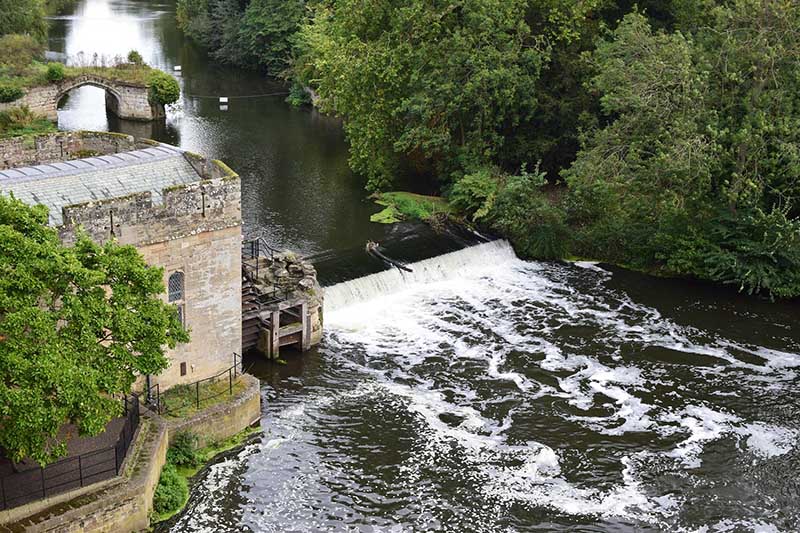
The evening, however, took a slightly different turn. Because after Warwick Racecourse we all found ourselves transported to the rather magnificent surroundings of Warwick Castle.
Now, if you’ve never been to Warwick Castle, imagine arriving somewhere that makes you immediately question whether you should have worn something slightly more medieval.
A spectacular banqueting hall, centuries of history in the walls, long wooden tables, and just enough grandeur to make you sit up slightly straighter when you take your seat.
It was a fantastic social evening. And something interesting happens at industry gatherings like this. The lines blur.
Not in a dramatic way — no one suddenly becomes lifelong friends over a starter and a glass of wine — but in a quieter, more human way.
Those familiar faces you’ve seen at conferences for years.
The people you’ve stood next to at exhibition stands.
The ones you’ve exchanged polite industry conversation with more times than you can count.
Over time, they begin to move categories.
They’re no longer just “someone I know from the industry.”
They start to become the people where you know a little bit more about life outside the job.
You know who has children.
You know who has just finished a house extension.
You know who is working on a new professional project or quietly planning the next stage of their career.
It doesn’t fully cross into close friendship — but it moves far enough that the conversations change.
And that’s where the best conversations happen.
Because suddenly there is no sales talk.
No product pitch.
No “what are you seeing in the market right now?” exchanges.
Just genuine curiosity about what makes people tick.
It’s funny really.
We spend so much of our professional lives talking about retail problems, industry trends, loss, technology, margin pressure and operational headaches.
But when you remove all that for an evening, what you are left with is simply a group of interesting people who happen to work in the same sector.
And that, in many ways, is what makes this industry such a good one to be part of.
Retail risk, loss prevention, operations, technology — it’s a surprisingly small world.
People move companies.
Roles change.
Businesses evolve.
But the community remains remarkably consistent.
You bump into the same good people again and again over the years, and those repeated meetings slowly build something valuable.
Trust.
Not the formal kind that appears in contracts or partnerships. The quieter kind that develops when you’ve shared enough conversations over enough years to know the person sitting across the table is genuine.
That’s something our industry doesn’t talk about enough.
Relationships matter. Not networking. Not the business-card collecting version of “connections.”
Real relationships.
The ones that are built gradually, over time, through shared experiences, honest conversations and the occasional castle banquet thrown in for good measure.
So thank you again to the Zebra team for a brilliant day and a memorable evening.
Great hosts. Great discussion. Great company.
And proof — if it were needed — that sometimes the most valuable part of an industry event isn’t the technology on display or the presentations on the stage.
It’s the conversations that happen once the slides are turned off.
And occasionally… when you find yourself having them in a medieval castle.